Newsroom
December 3, 2025
How to Create Low-Stakes Holiday Traditions with your Chosen Family
Remember how the holidays used to feel when you were younger? The excitement, the rituals, the sense that something special was happening, even if it was just sitting on the couch watching the same movie. The magic wasn’t in the plan. It was in the feeling.
And every year, as the holidays approach, many of us, especially Gen Z, are longing for that feeling again. Not just out of nostalgia, but because the desire for real connection feels more urgent than ever. But between packed calendars, rising social expectations, and constant emotional output, the way we connect now often feels less magical and more like a chore.
That’s why this season, Hinge is encouraging people to bring back the magic through low-stakes traditions: easy, affordable rituals that don’t require much planning or pressure, but still deliver something lasting.
And they come at a time when connection feels both more important and more draining than ever.
Why Low-Stakes Traditions Matter
“Low-stakes traditions don’t require much,” says Moe Ari Brown, LMFT, Hinge’s Love & Connection Expert, “but they give us a sense of belonging, ease, and emotional safety, and that’s the kind of connection people are really craving this time of year.”
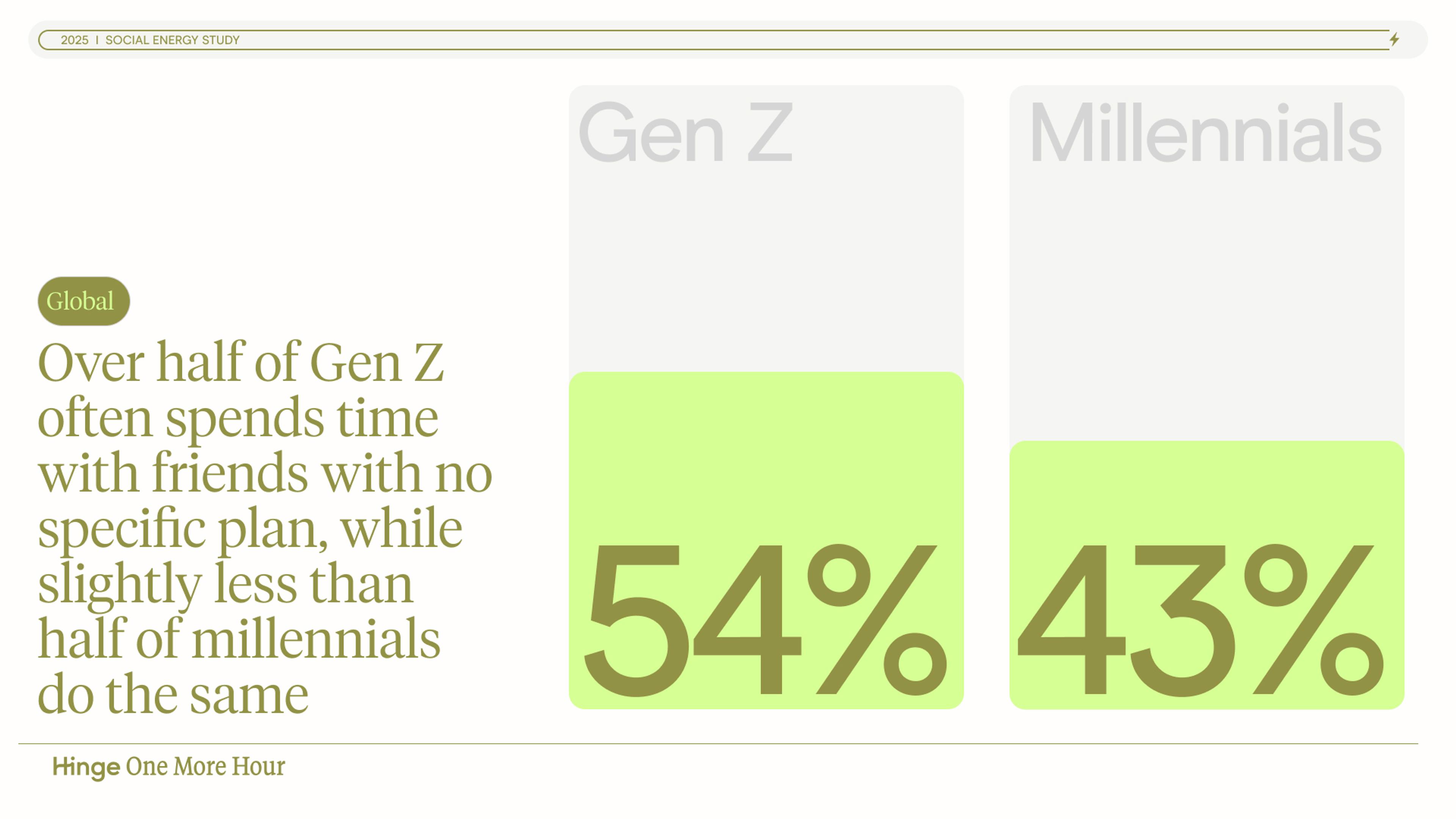
And they’re already resonating with Gen Z. According to Hinge’s Social Energy Study, conducted as part of its One More Hour initiative, 54% of Gen Z globally say they often hang out with friends without a specific plan, compared to 43% of millennials. This speaks to a broader generational shift: connection is becoming more about ease and less about structure.
At Hinge, we’ve been calling these simple memories, but during the holidays, they become something more: a way to bring back the magic without the social burnout.

What Psychology Tells Us
“Our brains are wired to deepen our bonds when we experience novelty and shared joy,” says Moe Ari Brown. “Neuroscience shows that novel experiences activate the brain’s reward centers. When those positive emotional experiences are shared, such as laughing at the same moment when you’re trying something new, oxytocin levels increase. That’s the same hormone that is responsible for how both our positive and negative social memories get encoded. When oxytocin increases in response to positive social experiences, we are far less likely to fear rejection in those relationships and feel a strengthened connection and increased trust.”
7 Low-Stakes Traditions to Try This Season
These are seven holiday rituals you can do in person that feel timeless and encourage connection:
- Game night: One person brings the games, and another can bring snacks. Play invites ease and authenticity. Laughter lowers everyone’s guard and turns the room into a place where people can relax.
- Holiday-themed movie night: Pick one person’s place, have everyone show up in cozy clothes, and rotate who brings the snacks or drinks. Watching a familiar or new holiday movie together creates a shared memory. People can simply exist beside one another while comfort fills the space.
- Playlists: Have each person add 2–3 songs to a shared playlist on the spot. Building a playlist during a hangout invites everyone to add a piece of themselves. Music helps the group sync energetically. By the end, the playlist becomes a memory you can carry long after the gathering ends.
- Potluck: Each person brings one thing they made or can easily pick up. A potluck turns nourishment into a communal act. It reminds the group that care is something you build together, not something one person has to carry alone.
- Storytime circle: A storytime circle brings out the softest parts of us. One person kicks it off with a short piece to share by reciting aloud, and others can follow, or just listen. Whether someone reads a poem, a quote, or a short passage, story-sharing builds emotional safety by helping people feel seen.
- Comfort item swap: Each person brings a small comfort and leaves with someone else’s. It is an easy way to say, “Here is a piece of what soothes me.” Everyone ends the night with a token of care.
- Shared timeline mapping: The host offers a big sheet of paper and markers or just use a table and index cards. Each person adds one moment from their year onto a communal timeline, and the map becomes a living portrait of the group’s collective journey. Seeing everyone’s highs and lows in one place helps the group feel intertwined rather than separate.
The holidays don’t have to be centered around grand gestures. They’re about the moments that tend to stay with us and bring us closer.
One More Hour of What Matters
- One More Hour is Hinge’s social impact initiative designed to help young adults feel less lonely in their day-to-day lives. Because we know the holistic well-being of our daters leads to better dates and deeper relationships. When people feel emotionally supported and connected in every part of their lives, they’re more likely to show up in dating with openness, clarity, and intention.
- One More Hour exists to help people develop healthier, more sustainable social routines, challenge the stigma of loneliness, and make in-person connections feel more accessible. That’s why we’re encouraging young adults to spend one more hour this season in intentional, IRL connection.
About Hinge’s Social Energy Study
From May 2025 to July 2025, Hinge, in partnership with FOOD and ON ROAD, conducted a mixed-method global study to better understand how Gen Z is navigating connection today. The research surveyed 10,000 participants aged 18–65 across five countries (U.S., U.K., Australia, France, and Germany), complemented by in-depth qualitative methods including digital diaries, online interviews, and in-person ethnographic observation. Together, these approaches provided a comprehensive view of how social habits, energy levels, and community rituals shape young adults’ experiences of connection and loneliness.