Newsroom
June 3, 2026
New Hinge Report Finds LGBTQIA+ Daters Are Prioritizing Clarity Over Ambiguity
3 Things to Know from Hinge’s 2026 LGBTQIA+ D.A.T.E. Report
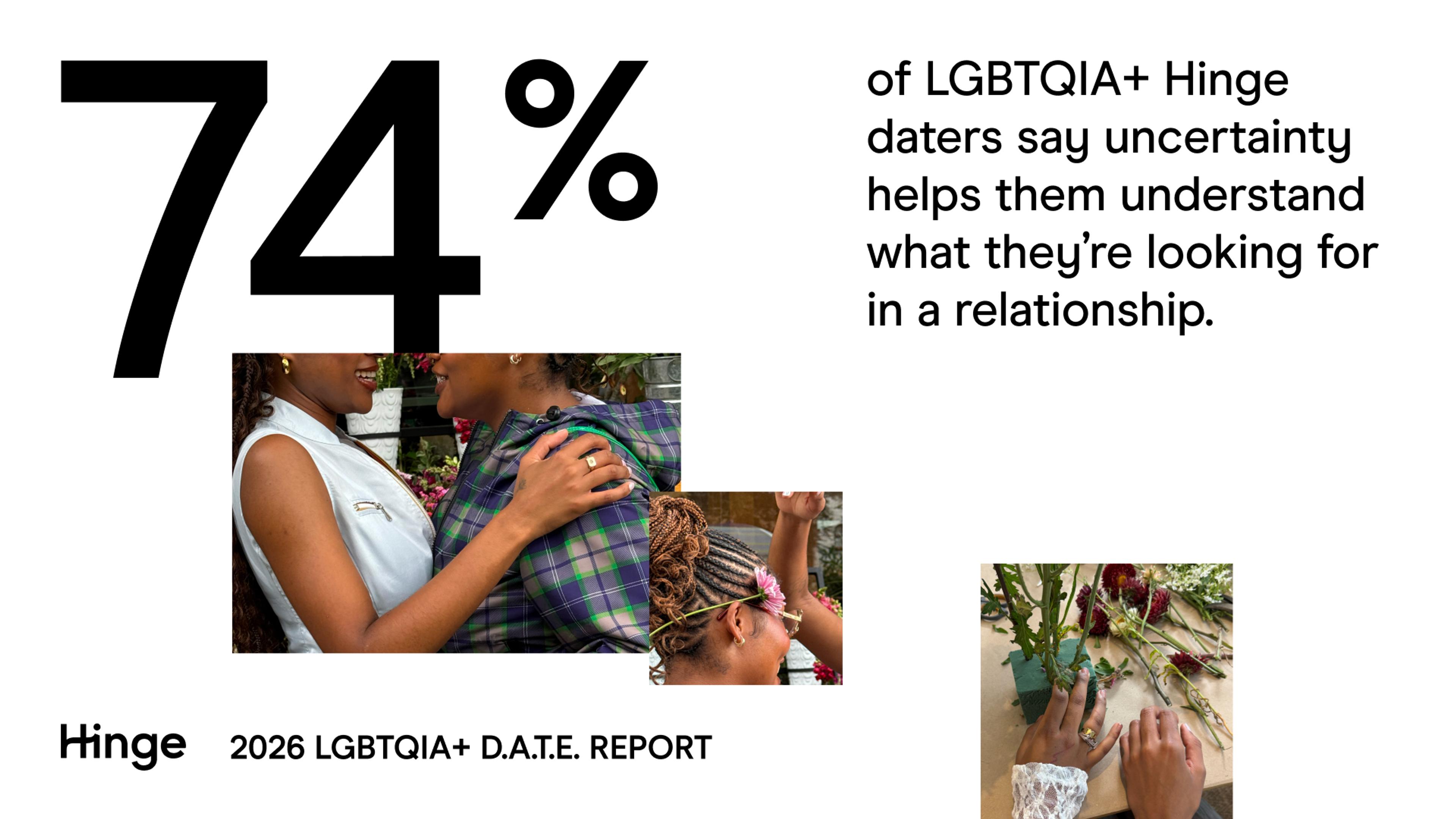
1. LGBTQIA+ daters are replacing mixed signals with clarity. In an increasingly uncertain world, LGBTQIA+ daters are becoming less interested in ambiguity and more interested in emotional safety, consistency, and knowing where they stand. 74% of LGBTQIA+ daters say uncertainty helps them understand what they’re looking for in a relationship.
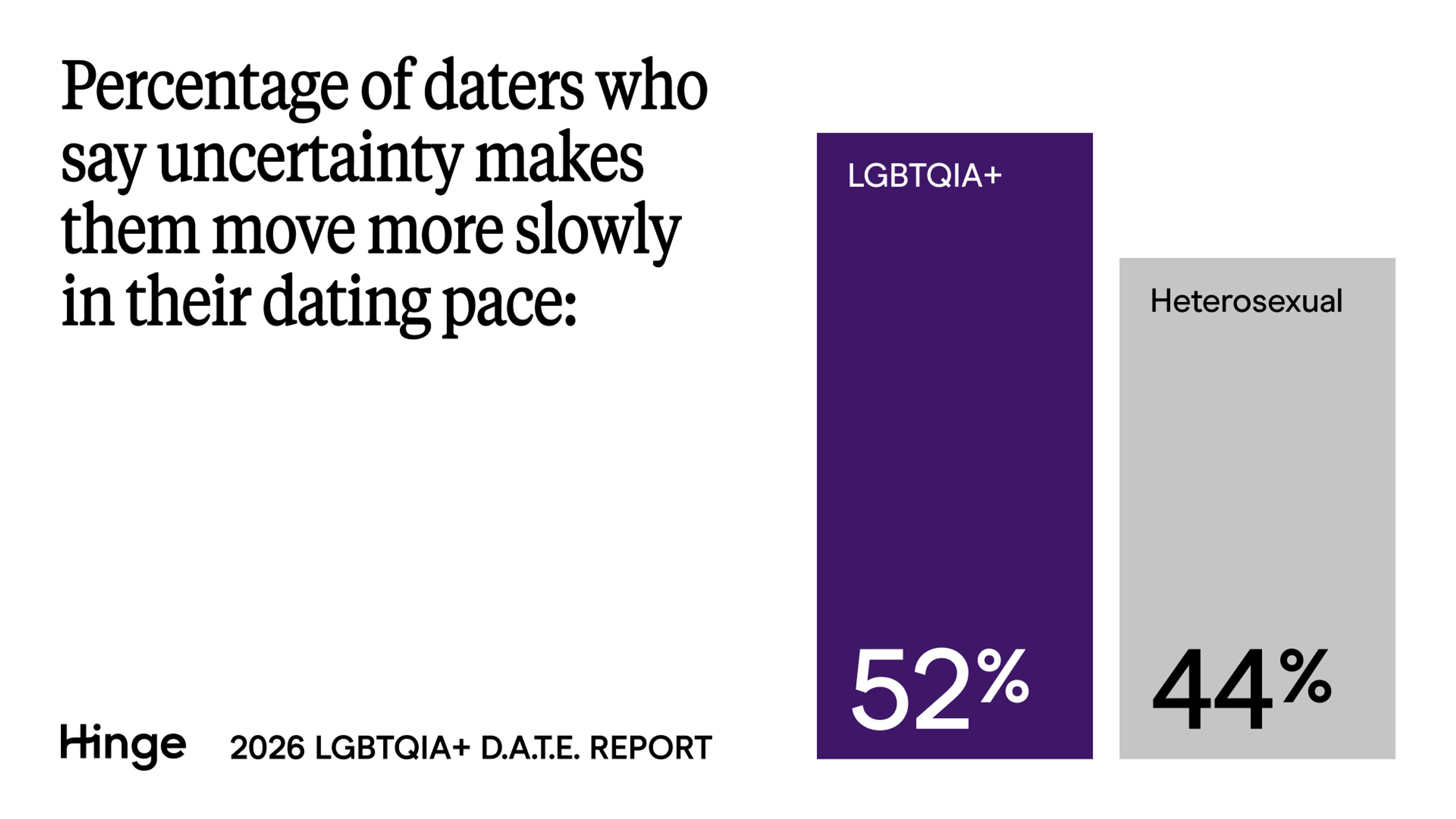
2. ‘Show, Don’t Tell’ Dating is replacing Dating with a Deadline. Rather than rushing toward milestones or defining relationships on a set schedule, uncertainty is leading LGBTQIA+ daters to slow down and pay closer attention to how someone actually shows up over time. 52% of LGBTQIA+ daters say uncertainty makes them move more slowly in their dating pace, compared to 44% of heterosexual daters.
3. Small gestures carry more emotional weight. LGBTQIA+ daters are 31% more likely than heterosexual daters to say uncertainty increases their need for reassurance in dating. From Public Displays of Affection (PDA) to what Hinge calls Private Displays of Consistency (PDC), LGBTQIA+ daters are finding intimacy in small, repeated signals of care.
As the world feels increasingly uncertain, LGBTQIA+ daters are getting clearer about what they want from relationships.
Hinge’s fourth annual LGBTQIA+ D.A.T.E. (Data, Advice, Trends, and Expertise) Report, Clarity Builds Chemistry, reveals that LGBTQIA+ daters are becoming less interested in ambiguity and more interested in consistency. Drawing on insights from more than 31,000 global LGBTQIA+ and heterosexual Hinge daters – alongside guidance from Hinge’s Love and Connection Expert Moe Ari Brown (he/they), LMFT, and Lead Relationship Scientist Logan Ury (she/her) – the report highlights how LGBTQIA+ daters are slowing down and paying closer attention to who consistently shows up over time.
Here’s what daters told us in our new D.A.T.E. Report:
For Queer Daters, Consistency Feels More Romantic Than the Spark Right Now
The report identifies a growing emphasis on what Hinge calls Private Displays of Consistency (PDC): the repeated, behind-the-scenes actions that turn interest into trust.
It’s the midday check-in about each other’s day. The remembered detail from a conversation three weeks ago. The idea that turns into an actual plan and is kept instead of being canceled. What used to be dismissed as “boring” is now becoming one of the clearest signals of emotional investment for LGBTQIA+ daters.
- 76% of LGBTQIA+ daters feel deeply uncertain about the world, yet they are 23% more likely than heterosexual daters to say that uncertainty significantly clarifies what they’re looking for in a relationship.
- LGBTQIA+ daters are 32% more likely than heterosexual daters to feel uncertainty at a high level.
- 86% of LGBTQIA+ daters say consistent communication from someone they’re dating makes them feel less anxious.
When the world already feels chaotic, LGBTQIA+ daters aren’t looking to add more uncertainty to their romantic lives. They’re paying attention to who follows through, who checks in, and who makes them feel emotionally safe instead of confused.
“When everything around you feels unpredictable, the small signs that someone is steady and emotionally safe start to matter a lot more.”
Joy Julia Callwood, she/her, 25, U.S.

LGBTQIA+ Daters Are Setting Their Own Pace With ‘Show, Don’t Tell’ Dating
For many LGBTQIA+ daters, uncertainty is reshaping the pace of relationships. LGBTQIA+ daters are slowing down and allowing compatibility to reveal itself over time through someone’s actions through “Show, Don’t Tell” Dating, prioritizing this over “Dating with a Deadline.”
- 76% of LGBTQIA+ daters prefer to focus on slowly building a connection with someone rather than moving on a certain timeline, compared to 64% of heterosexual daters.
- 52% of LGBTQIA+ daters say uncertainty makes them move more slowly in their dating pace, compared to 44% of heterosexual daters.
- LGBTQIA+ daters say that, before talking about a romantic future with someone, knowing their values (84%), if they feel comfortable around them (80%), and their intentions (77%) rank higher than life goals (59%), family life (28%), and finances (26%).
“For LGBTQIA+ daters, where safety and visibility are layered into every stage of dating, this matters even more. Words can be aspirational, but behavior over time, and your feelings in the relationship are all evidence. Slowing down is what gives you access to that insight,” advises Moe Ari Brown, Hinge’s Love and Connection Expert, in the report.
“Instead of asking ‘Do I like what they're saying?’ try: ‘Do I feel more grounded or more unsettled around how they actually show up?’ Your nervous system registers consistency or inconsistency before your mind catches up,” says Moe Ari.
The Big Question for LGBTQIA+ Daters: ‘Am I Proud To Bring Them Around My Friends?’
At a certain point, dating stops being about how someone shows up on a date and starts being about how they show up in your life.
For many LGBTQIA+ daters, friends are chosen family as the people who know you best, protect you, and see the most honest version of you. That’s why bringing someone into your circle of friends can feel like a much bigger relationship step than defining the relationship itself.
- LGBTQIA+ daters are 33% more likely than heterosexual daters to say they introduce someone they’re newly dating to friends because it mattered that their friends liked the person they were dating.
- LGBTQIA+ daters are 20% more likely to say they introduce someone to friends to see whether the person fits into their circle.
- LGBTQIA+ daters are 18% more likely to introduce someone to friends so the other person could understand them better.
“What I notice most is how someone interacts with my friends — are they genuinely curious about them, and do their stories line up with what they’ve told me? That’s where actions start to reveal someone’s character.” — Danh Doan (@danhdoanmua), he/him, 26, AUS
LGBTQIA+ Dating in 2026
In 2026, clarity is what builds chemistry. The old dating lore that warned against seeming “too available” is losing relevance. For many LGBTQIA+ daters, emotional visibility and reassurance are becoming the new signals of desire.
At a moment when so much feels unstable, romantic reassurance is essential.
Building a Less Lonely World
Hinge’s D.A.T.E. Reports are part of the app’s mission to create a less lonely world by inspiring intimate, in-person connections. Produced by Hinge Labs, a team of PhD researchers and behavioral scientists, each report translates real dating experiences into actionable insights designed to help daters build meaningful relationships.
What Else You Can Find in Hinge’s 2026 LGBTQIA+ D.A.T.E. Report
Methodology:
Hinge’s D.A.T.E. Reports are produced by Hinge Labs, an internal team of PhD researchers and behavioral scientists dedicated to generating evidence-based insights on modern dating. In January 2026, the team surveyed more than 31,000 global respondents, including LGBTQIA+ and heterosexual daters. Using both quantitative and qualitative methods, Hinge Labs studies what leads to successful relationships — and applies those insights to build a more effective dating app.